
Kimball Physics designs and manufactures the ultra-high vacuum (UHV) and extreme-high vacuum (XHV) chambers used in many high vacuum applications, including trapped-ion and neutral-atom quantum computing platforms worldwide. This guide covers the foundational physics, the major qubit hardware platforms, and the specific role precision vacuum technology plays in enabling them — with detailed reference to the Multi-CF™ chambers, eV Parts™ in-vacuum components, electron-gun systems, and detectors that researchers integrate into their apparatus.
Special focus is given to the ways in which Kimball Physics Multi-CF™ UHV Vacuum Chambers, Multi-CF™ UHV Fittings, eV Parts Modular Prototyping Components , Electron Gun Systems, and Detectors contribute to Quantum Computing Computing and Research across multiple hardware platforms.
At a Glance
|
SECTION 1
Classical computers process information as bits — binary values of 0 or 1. Quantum computers instead exploit the laws of quantum mechanics through quantum bits (qubits), which can represent and process information in fundamentally different ways. Three phenomena underpin this difference:
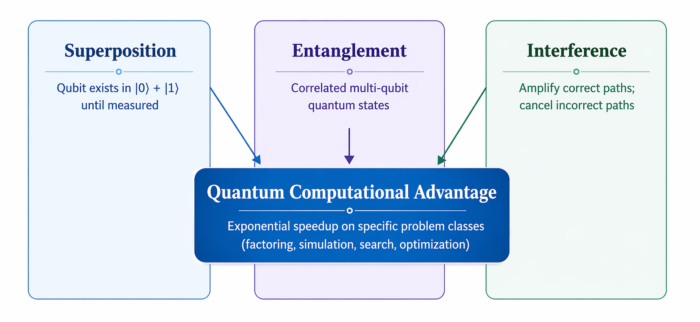
Quantum computers are not universally superior to classical computers. Their advantage is specific to problem structures — most notably quantum system simulation, integer factorization, database search, and certain optimization problems — while classical hardware remains more efficient for the vast majority of computing tasks.
SECTION 2
| Term | Definition |
|---|---|
| Qubit | The basic unit of quantum information. Physically realized as a superconducting circuit, trapped ion, neutral atom, photon, or electron spin. |
| Coherence Time (T₁, T₂) | T₁: duration before a qubit decays to ground state. T₂: duration before phase relationship is randomized. Longer coherence allows deeper circuits. |
| Gate Fidelity | Accuracy of a quantum logic operation, expressed as a percentage. Single-qubit gates achieve >99.9% in leading platforms; two-qubit gates are more demanding. |
| Decoherence | Loss of quantum information through uncontrolled interaction with the environment — thermal phonons, EM fields, magnetic fluctuations, background gas collisions. |
| NISQ Era | Noisy Intermediate-Scale Quantum era — the current period with tens to hundreds of noisy physical qubits, before full error correction is achieved. |
| Quantum Error Correction | Techniques encoding one logical qubit across many physical qubits to detect and correct errors without collapsing quantum state. |
| Term | Definition |
|---|---|
| Paul Trap | Confines charged ions using static and oscillating (RF) electric fields. The primary trap geometry for quantum computing. Requires UHV (<10⁻¹⁰ Torr). |
| Surface Trap | Microfabricated trap with all electrodes in a single plane; ions trapped above surface. Enables lithographic fabrication of complex electrode geometries. |
| Magneto-Optical Trap (MOT) | Uses counter-propagating laser beams and a magnetic field gradient to simultaneously cool and confine neutral atoms. Requires six-direction optical access. |
| Optical Tweezers | Tightly focused laser beams trapping single neutral atoms. Arrays of hundreds of tweezers create individually addressable qubit registers. |
| Rydberg Excitation | Promotion of a neutral atom to a high principal quantum number state. Rydberg atoms interact strongly at distances of several micrometers, enabling entangling gates. |
| Josephson Junction | Thin (~1–3 nm) insulating barrier between two superconductors. Quantum tunneling of Cooper pairs creates nonlinear inductance used to form the transmon qubit. |
| UHV / XHV | Ultra-High Vacuum: below 10⁻⁹ Torr. Extreme High Vacuum: below 10⁻¹¹ Torr. The operational environment of all atomic qubit platforms. |
| ConFlat® (CF) Flange | Industry-standard UHV sealing using knife-edge geometry biting into a copper gasket under bolt compression. Reliable at pressures below 10⁻¹² Torr. |
| Algorithm | Problem Solved | Speedup vs. Classical |
|---|---|---|
| Shor’s Algorithm (1994) | Integer factorization | Exponential — breaks RSA-2048 with ~4,000 error-corrected logical qubits |
| Grover’s Algorithm (1996) | Unstructured database search | Quadratic — reduces O(N) to O(√N) |
| VQE (Variational Quantum Eigensolver) | Ground-state molecular energy | Exponential for exact classical simulation of large quantum systems |
| Quantum Phase Estimation (QPE) | Eigenvalues of a unitary operator | Exponential in precision; subroutine of Shor’s algorithm |
SECTION 3
| Platform | Physical Qubit | Temp. | T₂ Coherence | UHV? |
|---|---|---|---|---|
| Superconducting | Josephson junction (transmon) | 10–20 mK | 50–300 µs | No (dilution fridge) |
| Trapped Ion | Charged ions (Ca⁺, Yb⁺, Ba⁺) | Room temp. (UHV) | Seconds to minutes | Yes — critical |
| Neutral Atom | Neutral atoms in optical tweezers | Room temp. (UHV) | Seconds | Yes — critical |
| Photonic | Photon polarization / path / mode | Room temp. | Limited by photon loss | Partial |
| Silicon Spin | Electron spin in quantum dot | ~100 mK | Seconds (nuclear spin) | No (dilution fridge) |
| Topological | Majorana zero modes | ~100 mK | Theoretically protected | No (dilution fridge) |
As of late 2023, the largest fully controllable entangled system involved 32 trapped ions in a single chain. Coherence times for hyperfine qubits (e.g., ¹⁷¹Yb⁺) routinely exceed 10 minutes, and two-qubit gate fidelities approaching 99.9% have been demonstrated.
SECTION 4
SECTION 5
|
For trapped-ion and neutral-atom quantum computers, ultra-high vacuum (UHV) is the operational environment of computation, not merely a peripheral requirement. A single collision between a qubit and stray gas molecule can end the calculation. |
| Pressure | Classification | Quantum System Use |
|---|---|---|
| 10⁻³ Torr | Medium vacuum | Rough pumping; initial evacuation stage |
| 10⁻⁶ Torr | High vacuum | Ion source / atom oven region; SEM/TEM characterization |
| 10⁻⁸ – 10⁻⁹ Torr | UHV (entry) | 2D-MOT loading chamber; initial laser-cooling stage |
| 10⁻¹⁰ – 10⁻¹¹ Torr | UHV (science) | Ion trap science chamber; neutral atom BEC / tweezer array |
| <10⁻¹¹ Torr | XHV | Highest-fidelity ion trap QC; long-coherence optical clocks |
Figure 2. Vacuum pressure scale — from atmosphere to XHV, showing operational regimes for quantum hardware
SECTION 6
Reaching pressures below 10⁻¹¹ Torr (XHV) requires aggressive control of outgassing from all internal surfaces. The dominant outgassing species in baked-out stainless steel chambers is dissolved hydrogen — molecular H₂ that diffuses from the bulk metal to the surface over time. Titanium typically has an outgassing rate of hydrogen significantly lower than Stainless Steel. The stable oxide layer on the Titanium surface limits that rate of hydrogen desorption at the surface.
| Property | 316L Stainless Steel | Titanium Alloy |
|---|---|---|
| H₂ outgassing rate (after bakeout) | ~1–3 × 10⁻¹² Torr·L·s⁻¹·cm⁻² | ~10⁻¹³ – 10⁻¹⁴ Torr·L·s⁻¹·cm⁻² |
| Improvement factor | — | 10–100× lower |
| Achievable ultimate pressure | ~10⁻¹⁰ – 10⁻¹¹ Torr | <10⁻¹¹ – 10⁻¹² Torr |
| Pressure classification | UHV grade | XHV grade |
| Magnetic permeability | ~1.003–1.007 | ~1.0001 |
| CF compatibility | Full | Full — direct drop-in replacement |
Figure 3. Titanium vs. stainless steel outgassing comparison — H₂ outgassing rate, magnetic permeability, and achievable pressure
SECTION 7
Kimball Physics Multi-CF™ (MCF™) vacuum chambers are precision CNC-machined from a single monolith of 316L stainless steel or titanium alloy. Their design philosophy — maximum internal access, minimal welds, spherical geometry with dense multi-port access — makes them exceptionally well-suited for quantum computing and quantum sensing apparatus.
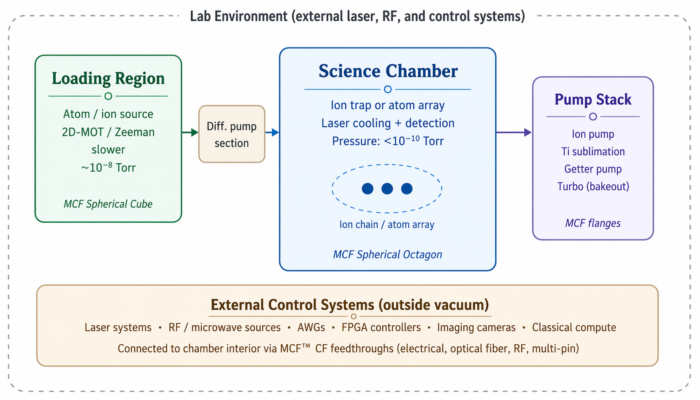
Figure 4. Schematic of a typical trapped-ion / cold-atom quantum system showing Kimball Physics MCF™ hardware at each stage
Interactive Model of a 6.00″ Multi-CFTM Spherical Octagon UHV vacuum chamber with 2 primary 6.00″ CF ports and 8 2.75″ peripherial CF ports. Note the “Grabber Groove” at all apertures for clamping and supporting hardware inside the chambers. Model #: MCF600-SphOct-F2C8
| Chamber Model | Main Ports | Side Ports | Quantum Use Case |
|---|---|---|---|
| 6.0″ Spherical Octagon | 2 × 6.00″ CF | 8 × 2.75″ CF | Cold atom MOT / BEC; ion traps with full laser access |
| 8.0″ Spherical Octagon | 2 × 8.00″ CF | 8 × 2.75″ CF | Larger ion trap arrays; neutral atom tweezer arrays; multi-species |
| 4.50″ Spherical Cube | 6 × 4.50″ CF | 8 × 1.33″ CF | Compact ion trap systems; electron / ion gun experiments in UHV |
| 2.75″ Spherical Cube (Mini) | 6 × 2.75″ CF | Variable | Miniaturized ion traps; compact quantum sensors and clocks |
| Sub-miniature (0.95″ CF) | Miniature CF array | Variable | Chip-scale ion traps; rack-mounted quantum hardware |
Please visit the Multi-CF Vacuum Chamber and Hardware Overview in the Learning Center for more in depth discussion of the vacuum chambers and hardware.
Please visit our Muti-CF Vacuum Chambers Interactive 3D Experience in the Learning Center to interactively view many of the various UHV vacuum chamber configurations that are available.
Also, Please visit our Multi-CF Mini and Sub-Mini UHV Vacuum Chamber and Component Overview in the Learning Center to learn more about the configurations and capabilities.
The citations below are a partial list of references we found from a general online search of the technical and scientific literature. We continue to update our citations with additional references. Please reach out if we have missed any citing or applications or if we have made an error in any listing.
| Partial List of Citations |
|
SECTION 8
The eV Parts system — a collection of over 350 standardized, high-vacuum-compatible components — is described as “an Erector Set® or LEGO® set for scientists.” Developed originally in the physics research lab, the toolkit has been in continuous use for nearly six decades.
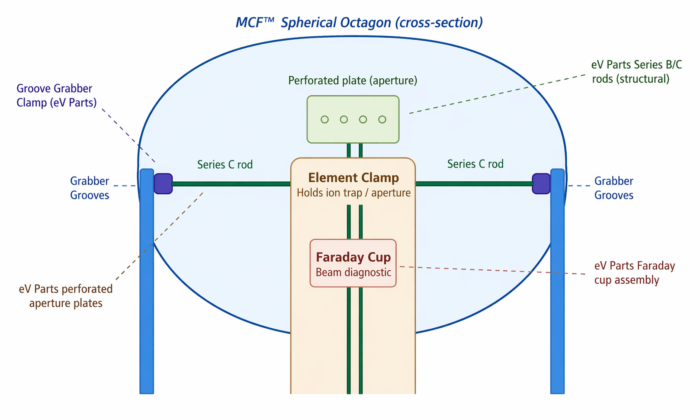
Figure 5. Cross-section of a Kimball Physics Spherical Octagon chamber showing eV Parts components — Groove Grabbers, Series C rods, Element Clamp, and Faraday cup
| Component | Description | Quantum Application |
|---|---|---|
| Groove Grabber™ Clamps | Not technically an eV Part, Groove Grabber Precision clamps engage internal channels in MCF™ chamber ports (2.75″–10.0″ CF) | Mount ion trap chips and atom chip assemblies inside chamber without additional vacuum penetrations |
| Series B and C Rods | Precision rods in metallic (SS, titanium) and insulating (alumina ceramic) materials | Structural members for lens stacks, trap support frameworks, electrode alignment fixtures |
| Perforated Plates | Plates with precision hole arrays in SS, titanium, and copper | Apertures for beam geometry control; grids for electric field control; Faraday cup collector plates |
| Element Clamps | 2-, 4-, and 8-pointed clamps for mounting rods in angular arrangements | Create rigid lens stack and source assemblies for electron-impact ionization of neutral atoms |
| Wound Wire Stock (SS 304) | Stainless steel wound wire for low-current electrical connections | Low-current electrical leads inside vacuum for diagnostic sensors and electrode bias connections |
| Fasteners and Standoffs | Screws, nuts, standoffs in 316 SS and titanium; gold-plated for lubrication | Assembly of all in-vacuum structures; gold plating prevents cold welding in UHV |
SECTION 9
| Quantum System Subsystem | Kimball Physics Product | Category |
|---|---|---|
| Science chamber (ion trap / neutral atom array) | Spherical Octagon, Cube, Hexagon (SS or Ti) | Multi-CF™ Chambers |
| Loading / MOT chamber | Smaller MCF™ chambers; Double Spherical Octagon | Multi-CF™ Chambers |
| Differential pumping connection | MCF™ compact cross fittings; Flange Multiplexers; close couplers | Multi-CF™ Specialty Fittings |
| Ion / getter pump ports | Standard CF flanges; weldable clusters; mounting flanges | Multi-CF™ Flanges |
| Optical viewport ports | MCF™ mounting flanges (viewport configuration); thin flanges | Multi-CF™ Fittings |
| Electrical feedthroughs | 0.95″ and 2.75″ CF feedthroughs (HV, multi-pin, BNC, SMA) | Multi-CF™ Feedthroughs |
| Internal trap / chip mounting | Groove Grabber™ clamps + eV Parts rod frameworks | eV Parts + MCF™ Mounting |
| Ion / electron beam diagnostics | Faraday cups; phosphor screen detector assemblies | Kimball Physics Detectors |
| Ion loading source | EFG-series low-energy flood electron gun systems; LaB₆ emitters | Electron Gun Systems |
| Surface science / qubit characterization | Electron gun systems; ion gun systems; LaB₆ cathodes; phosphor screens | Electron Guns/Ion Guns + Detectors |
| Compact / portable quantum sensors | Sub-miniature MCF™ chambers (0.95″–2.75″ CF); mini multiplexers | Multi-CF™ Sub-mini Systems |
SECTION 10
Trapped-ion and neutral-atom quantum computers store quantum information on individual atoms or ions held in electromagnetic or optical traps. A single collision with a stray gas molecule can eject the trapped particle and end the computation. UHV (<10⁻⁹ Torr) and XHV (<10⁻¹¹ Torr) reduce collision rates to less than one per minute, allowing meaningful coherence times and gate sequences.
Most trapped-ion quantum computers operate between 10⁻¹⁰ and 10⁻¹¹ Torr in the science chamber. The highest-fidelity systems push into XHV (<10⁻¹¹ Torr) using titanium chambers, NEG pumping, and extensive bakeout protocols.
UHV (ultra-high vacuum) chambers operate below 10⁻⁹ Torr; XHV (extreme-high vacuum) chambers operate below 10⁻¹¹ Torr. Reaching XHV typically requires titanium construction, all-metal seals, no internal welds, low-outgassing materials, and aggressive bakeout — features that distinguish a Kimball Physics 316L and titanium Multi-CF™ modular chambers from others.
The 4.5″ Spherical Cube and 6.0″ Spherical Octagon are the most common starting points for trapped-ion systems. The Spherical Octagon’s eight radial 2.75″ ports give simultaneous access for cooling, pumping, ionization, and imaging beams plus electrical feedthroughs and pumps. For larger trap arrays or multi-species experiments, the 8.0″ Spherical Octagon offers more port real estate.
The 6.0″ and 8.0″ Spherical Octagons are frequently noted as the standard science chambers for magneto-optical traps, BEC apparatus, and optical-tweezer arrays. Their dual large primary ports support high-NA imaging optics, while the eight radial 2.75″ ports accommodate the orthogonal MOT beams.
Yes. Multi-CF™ chambers can potentially be modified and machined to custom port patterns, materials (316L stainless or titanium), and dimensions. Many published QC apparatus papers explicitly cite a “custom Kimball Physics spherical octagon chamber.” Contact our applications engineers to discuss your geometry, port layout, and target pressure.
Section 11
If you are designing a vacuum chamber for a trapped-ion, neutral-atom, or cold-atom quantum computing apparatus, our applications engineers may be able to help you find the appropriate port geometry, material (316L vs. titanium), in-vacuum mounting, feedthroughs, and pumping integration or design a custom system specific for you application or research.
1. Hahn, Kotibhaskar et al. (2025). A Room-Temperature XHV System for Trapped-Ion QIP. arXiv:2512.11794
2. Clark, Lobser et al. (2021). Engineering the QSCOUT. IEEE Trans. Quantum Engineering. DOI: 10.1109/TQE.2021.3096480
3. Hogle, Dominguez et al. (2023). High-fidelity trapped-ion qubit operations. npj Quantum Information 9, 74. DOI: 10.1038/s41534-023-00737-1
4. Neri, Ciamei et al. (2020). Cold Mixture of Fermionic Cr and Li. Phys. Rev. A 101, 063602. DOI: 10.1103/PhysRevA.101.063602
5. Akbari, Alves et al. / ALPHA Collaboration (2025). The ALPHA-2 Apparatus. Nucl. Inst. & Meth. A 1072, 170194. DOI: 10.1016/j.nima.2024.170194
6. Shu, Dietrich, Kurz, Blinov (2010). Trapped Ion Imaging with a High NA Spherical Mirror. J. Phys. B 42, 154005. DOI: 10.1088/0953-4075/42/15/154005
7. Graham, Chen, Blinov et al. (2014). Barium Ions in a Microfabricated Surface Trap. AIP Advances 4, 057124. DOI: 10.1063/1.4878536
8. Sun, Buchman et al. (2008). Charge Neutralization in Vacuum. Class. Quantum Grav. 25, 035004. DOI: 10.1088/0264-9381/25/3/035004
9. Bruzewicz, et al. (2019). Trapped-ion quantum computing: Progress and challenges. Appl. Phys. Rev. 6(2), 021314. DOI: 10.1063/1.5088164
10. Shor, P.W. (1994). Algorithms for quantum computation: Discrete logarithms and factoring. Proc. 35th FOCS, pp. 124–134.
11. Grover, L.K. (1996). A fast quantum mechanical algorithm for database search. Proc. 28th ACM STOC, pp. 212–219.
12. Kimball Physics. Multi-CF (MCF) Vacuum Chamber and Hardware Overview. kimballphysics.com
13. Bluvstein, D. et al. (2022). Quantum processor based on coherent transport of entangled atom arrays. Nature 604, 451–456.
14. DOE Quantum Systems Accelerator (2024). An Atomic Beam of Titanium for Ultracold Atom Experiments. arXiv:2406.07779
Draft April 2026 · D.E. Altobell 2026_0415 , Update 5/5/2026
Kimball Physics, Inc. · Wilton, New Hampshire, USA · www.kimballphysics.com
Multi-CF™, Grabber Groove™, and eV Parts™ are trademarks of Kimball Physics, Inc. · ConFlat® is a registered trademark of Agilent Technologies.
