

Dr. Charles “Chuck” Kimball Crawford
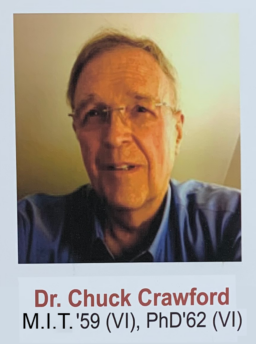
Founder of Kimball Physics, Inc.
Physicist · Inventor · Entrepreneur · Pilot · Philanthropist
July 9, 1937 – May 9, 2026
Dr. Charles “Chuck” Kimball Crawford, founder of Kimball Physics, Inc., passed away on May 9, 2026, in Peterborough, New Hampshire. He was eighty-eight years old. A physicist of rare distinction, Chuck spent more than five decades advancing the science and technology of charged particle beams and UHV vacuum system components — work that touched electron microscopy, semiconductor manufacturing, space exploration, university and government research facilities, and medical research — all from a hilltop campus in rural Wilton, New Hampshire, guided by a mission he never wavered from: to advance humankind by doing good physics.
Education and Early Career
Born on July 9, 1937, in New Jersey, Chuck earned his S.B., S.M., and Ph.D. degrees — all in Electrical Engineering (Course VI) — from the Massachusetts Institute of Technology, graduating with his doctorate in 1962. As a graduate student, he worked in the laboratory of Professor Dudley Buck, a pioneering researcher in superconducting computing, where he mastered electron beam optics and vacuum technology at a time when both fields were in their infancy. Following Buck’s untimely death in 1959, Crawford helped hold the research program together before completing his own doctoral work.
After receiving his PhD, Chuck served as an MIT professor for eleven years, teaching graduate and undergraduate courses in the Departments of Electrical Engineering and Physics, and heading the Particle Optics Laboratory. He also taught Applied Physics at Harvard. During this period, he began developing modular vacuum instrument components that could be used for the cost-effective and efficient creation of new concepts and prototypes, helping graduate students more quickly complete their projects. These “eV” parts evolved into a full system of components, often called “erector sets for physicists” — they became the direct precursor to Kimball Physics’ foundational eV Parts product line.
Kimball Physics, Inc.
In 1969, Chuck left his MIT full professorship to found Kimball Physics, Inc. (KPI) in Wilton, New Hampshire, naming the company after the Kimball Heights Farm property his family had owned since 1801. What began as a small instrument maker grew over fifty-five years into a world-renowned manufacturer of ultra-high vacuum hardware, electron and ion sources, and precision beam optics — with customers in research institutions, national laboratories, and high-technology industries across the globe. He was able to motivate and inspire his employees to bring forward their best in creativity and productivity to create world-changing products and technology. And for most years, Kimball Physics had a summer internship program to teach and inspire future physicists and potentially future Kimball Physics employees and creators.
Under Chuck’s leadership, KPI achieved a string of landmark accomplishments:
IR-100 Awards. Kimball Physics won two IR-100 Awards — among the most prestigious recognitions in technology and innovation — for the KPI-ES310 Lanthanum Hexaboride (LaB₆) electron source (1975) and the System 2 Charge Neutralizer (1980), each selected as one of the year’s 100 Most Significant New Technical Products.
Lanthanum hexaboride cathodes. Chuck’s sustained research into LaB₆ — a crystalline material with a dramatically lower work function than conventional tungsten — produced electron sources more than ten times brighter than the industry standard. He developed a novel heating system to optimize the cathodes lifetime and functional consistency that continues to be used today. These cathodes became enabling technology for scanning electron microscopes, electron beam lithography, and analytical instruments used in semiconductor manufacturing worldwide.
Space exploration. KPI technology contributed to NASA’s Wake Shield Facility Flight Program, a Space Shuttle-deployed platform designed to grow ultra-pure thin films in the vacuum of low Earth orbit. The company also developed electron gun systems used to simulate solar winds for satellite materials testing. Most recently, a Kimball Physics Multi-CF “mini” cube became part of NASA’s Cold Atom Lab (CAL) aboard the International Space Station, launched May 21, 2018 — an experiment studying ultra-cold quantum gases in microgravity that NASA has called “The Coolest Spot in the Universe.”
Medical innovation. A Kimball Physics electron source was used in the first free-electron laser surgery ever performed on a human being — a procedure at Vanderbilt University in which neurosurgeons successfully dissolved a benign brain tumor. The program’s lead scientists credited KPI’s product as essential to the surgery’s success.
Nine US Patents. Chuck held nine patents, all assigned to Kimball Physics, covering innovations in ultra-high vacuum flanges, manifolds, couplers, and sealing systems — hardware that made precision vacuum assemblies more compact, reliable, and easier to build.
Movie Industry. He even designed a custom electron gun prop for James Cameron’s 1984 film The Terminator.
Legacy
Chuck Crawford was equally known for his boundless energy and determination, mentoring, and generosity in advancing humankind through good physics. That focus at times was also directed to other important causes for humanity. Influenced by the untimely loss of a high school teacher and mentor to a tobacco-caused illness, Chuck was especially motivated to help reduce the extent of this unnecessary loss of life. He implemented one of the country’s first zero-tolerance tobacco policies — prohibiting even the scent of smoke on an employee’s person — years before such policies became common. He was a trustee of Action on Smoking and Health (ASH).

Chuck, in those rare moments when he was not thinking or working on Kimball Physics projects, was also an FAA certified commercial pilot, multi-engine rated pilot and certified flight instructor. He flew for many years and even provided free lessons to Kimball Physics employees interested in exploring the wild blue yonder.
He was also a former president of the New Hampshire High Tech Council, and a dedicated conservationist and philanthropist whose generosity shaped the town of Wilton for decades.
In 2014, he returned to MIT to give a lecture whose title captured his life’s philosophy perfectly: “Entrepreneuring: Attempting Good Physics while Accidentally Making Money.”
He is fondly remembered by his colleagues, his community, and the global scientific community — whose instruments and research he elevated to the next level, and whose work continues to reflect his conviction that good physics advances all of humankind.